

By Danyah Banaras
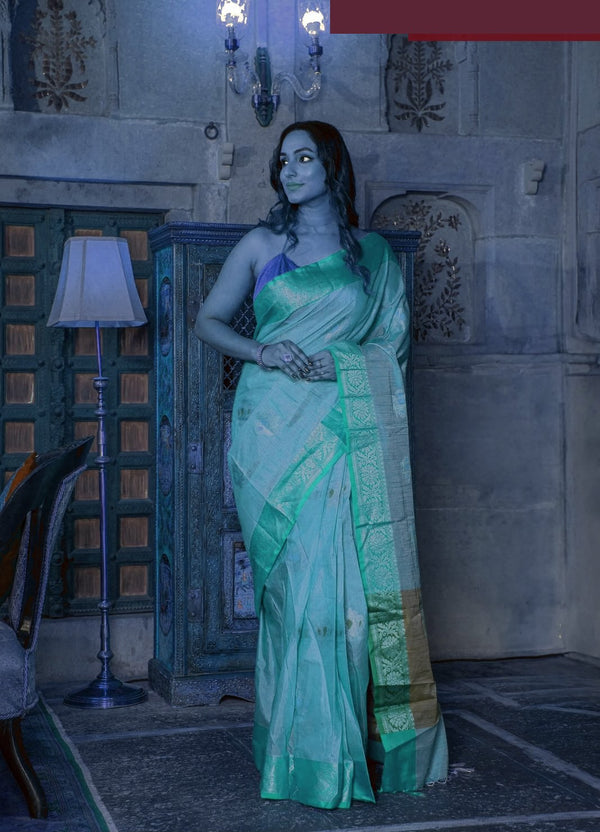
Danyah Banaras Cotton Silk With Pink Border Pre Draped Saree — Sapphire Mehfil
Rs. 3,999.00
From the Founder
Cotton was the original Banaras. Before silk arrived along the Silk Road, before zari, before the looms migrated indoors — the weavers of this riverbank wove cotton so fine it could be drawn through a signet ring. The English called it muslin. We called it shabnam — morning dew. Empires were built and broken over it.
The cotton in this room is hand-spun and hand-loomed from short-staple desi varieties grown in Bundelkhand and the eastern plains. It is not the long-staple commercial cotton that fills global supply chains; it is shorter, more honest, and it breathes the way only true khadi can. In July, when Mumbai turns to steam, this is the fabric that does not punish you for wearing six yards.
We weave these on the same pit looms used for our Katan silks — the same weavers, the same hands. The difference is the discipline of restraint. A cotton Banarasi does not shout. It rests against the skin, takes the sweat of the day, and carries a small flash of zari at the pallu only because the weaver could not resist.
Live in these. Pack them in your travel bag. They will outlast the suitcase.


Know What You're Wearing
Three things every Danyah buyer should know before they fold this saree into a trousseau.
The Weave
A Banarasi cotton is hand-loomed on the same pit looms as our silks, but woven from desi short-staple cotton spun on a charkha rather than imported on a cone. The fineness is measured in counts — 80s, 100s, 120s — referring to the number of hanks of yarn that go into a pound of cloth. Higher counts mean finer, more translucent fabric.
Our cottons sit between 80s and 100s — fine enough to drape with the softness of silk, sturdy enough to live in through a Bombay monsoon. The zari at the borders and pallu is real silver, gilded in gold, kept restrained because cotton does not carry heavy work the way silk does. A true Banarasi cotton breathes, takes a press well, and only softens with each wash — it is built for daily life over decades.
Authenticate
Care
Our Banarasi sarees are woven on traditional pit-looms in the bylanes of Madanpura, Varanasi — by master weavers whose families have been weaving for four to six generations. Each piece is hand-checked at our Mumbai atelier, finished, and paired with an authenticity certificate that lists the weaver's name, the loom number, and the exact silk and zari composition.
Whether you are shopping for a bridal Banarasi, a festive Katan silk, or a ready-to-wear pre-draped piece, every saree on Danyah Banaras carries the same promise: real silk, real zari, real craft.
ANSWERED, KINDLY
Slow answers to the questions our patrons write in about most often.
Every saree is woven on a pit-loom in Madanpura, Varanasi, by a named master weaver, and ships with an authenticity certificate that records the weaver's name, the loom number, and the exact silk and zari composition. Turn the saree over — a hand-woven piece shows individually cut and re-anchored zari floats on the reverse, like braille; a power-loom shows long, uniform floats.
Prices reflect the loom-hours, the silver content of the zari, and the silk grade. A light Banarasi or Tanchoi begins at ₹45,000; a mid-weight festive piece sits between ₹65,000 and ₹1,20,000; a kadhwa bridal saree in pure Katan silk with a sona-rupa pallu ranges from ₹1,40,000 to ₹2,80,000. The wage paid to the weaver is printed on every certificate.
In-stock sarees ship within 3–5 working days from our Mumbai atelier, with insured express delivery across India and to the UK, US, Singapore, UAE, Canada and Australia. International orders typically arrive in 5–9 days. Bridal commissions are made-to-loom and take four to seven months — book early to confirm a loom slot.
Dry-clean only, by a specialist who knows real zari. Between wears, wrap the saree in unbleached muslin — never plastic — and refold along a different crease every three months so the zari does not fatigue at a single line. Store away from direct sunlight and naphthalene. With this care, a kadhwa Katan silk Banarasi lasts a hundred years.
Yes. We accept colour, motif and zari-weight commissions on every weave we offer; a 30 percent deposit confirms the loom slot. Blouse stitching, fall-and-pico, and pre-draping are available on every saree at the Mumbai atelier. Write to atelier@danyahbanaras.com or book a video consultation from the Atelier Appointment page.
In-stock sarees may be returned or exchanged within 7 days of delivery, provided the saree is unworn, unwashed, and ships back with its original certificate and tags. Bridal commissions and made-to-order pieces are non-returnable but carry a lifetime re-weave guarantee on the zari. Full terms are on our Care and Promise page.
FREE GUIDE — DELIVERED INSTANTLY
A 24-page PDF from our atelier — Nivi, Bengali, Gujarati, Mumtaaz and 4 modern drapes. Photographed on real Banaras, Kota & Mashru silks.