
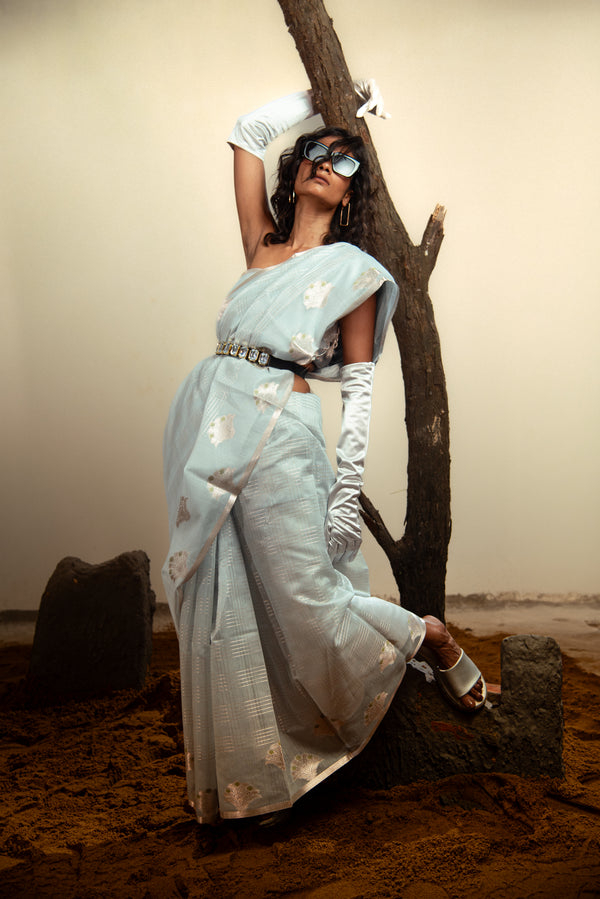

COTTON SAREE FOR OFFICE
Handloom Banarasi cotton sarees engineered for the modern workday — light enough for an eight-hour shift, structured enough for a board meeting, woven in Varanasi with the same precision we reserve for our bridal pieces.
A cotton saree for office is not a compromise on the saree tradition — it is the saree tradition returning to the body it was originally cut for. Long before Katan silk became the bridal default, the daily working saree of north Indian women was Banarasi cotton, often woven on the same looms that turned out the wedding pieces but at a lighter density. Danyah Banaras has revived that everyday working Banarasi cotton — softened with a touch of linen, brocaded with restraint, and sized in our pre-draped silhouette so a working woman can pleat on a cotton saree in sixty seconds before a 9 a.m. meeting. This page brings together the office-weight cotton sarees from our atelier — for the boardroom, the law chamber, the studio, and the long day that needs a textile that breathes.
An office cotton saree has to do three things at once: hold a professional silhouette through an eight-hour day, breathe in summer-warm conference rooms, and survive frequent gentle washing. Synthetic 'cotton-look' sarees fail on all three counts — they crease unpredictably, sweat-stain visibly, and pill within twenty wears. Pure handloom Banarasi cotton, in contrast, was woven for exactly these conditions. The mulmul and tangail cotton our weavers spin in Varanasi carries a 60-80 count thread (finer than department-store cotton, comparable to fine European poplin), and the brocade weight is calibrated for office wear, not banquet wear.
The everyday cotton saree weights we recommend for office wear sit between 360 and 480 grams for the full six yards. Anything heavier is bridal cotton; anything lighter loses the structure that makes a saree photograph as 'authoritative'. The border should be narrow — 1.5 to 3 inches — with restrained zari, not the wedding-weight 6-inch border with full meenakari. Body work should be subtle: a small buti repeat, a single line of jaal, or a clean unwoven field. Save the kadhua brocade for the wedding; the office wants the textile to recede behind the wearer, not compete with her.
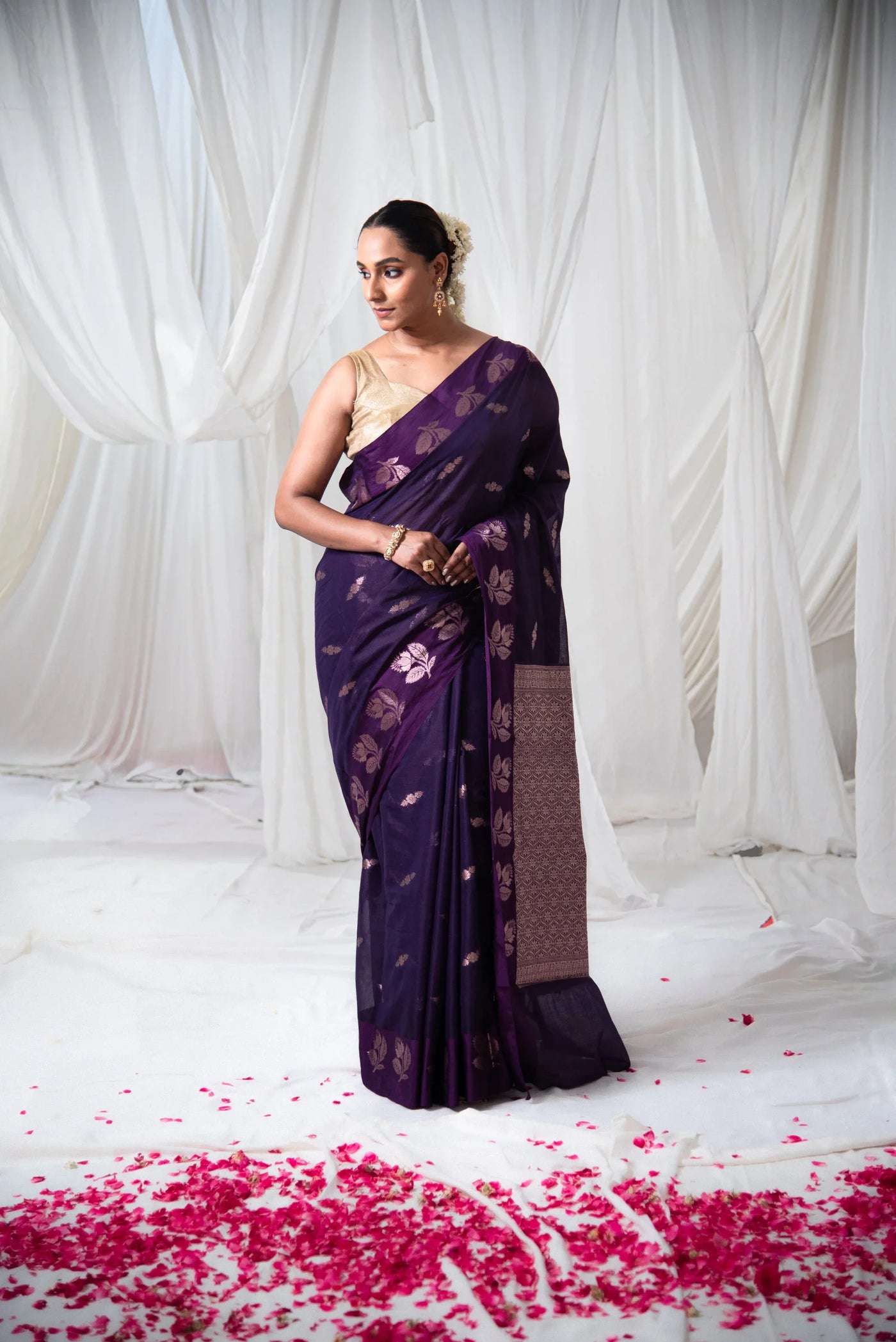
The colour vocabulary for an everyday office cotton saree is its own quiet education. Off-white, ivory, ash, and natural undyed cotton are the year-round professional defaults — they photograph well on video calls, pair with any blouse, and never read as 'overdressed'. Powder blue, sage, dusty rose, and pale grey are the seasonal extensions for spring and autumn. Black and deep navy are the law-firm and litigation choice — formal, restrained, photograph as 'serious'. For the woman who wants restrained colour: oxblood, rust, mustard, and forest green in pure handloom cotton are the high-formality picks that still read as work-appropriate. Save the brights for evening.
At Danyah Banaras the office cotton saree comes in three weave families. Pure Banarasi cotton mulmul is the softest, most breathable choice — best for summer and warm climates. Cotton-linen blend (our Linen Banarasi line) adds structure and longevity; the linen content (typically 30-40%) gives the saree a crisp drape that holds shape through a full day of sitting. Cotton-silk handloom is the formality-upgrade choice for client-facing roles and senior management; the silk warp gives a subtle sheen without crossing into 'evening'. Every cotton saree we sell carries the same provenance documentation as our silks — weaver name, loom-type, cluster of origin.
The single most important office innovation is the pre-draped cotton saree. Six yards of cotton draped traditionally requires fifteen to twenty minutes — and a working woman trying to get to a 9 a.m. meeting does not have that time. Our pre-drape stitches the pleats onto a fitted cotton petticoat (with deep pockets, on request), pre-pleats the pallu with concealed brass hooks, and lets you step into the saree in under a minute. The cotton breathes through a full day, the pleats stay knife-sharp, and the silhouette photographs identically whether you have just sat down or just stood up from a three-hour meeting. For the woman who has wanted to wear cotton sarees to office but felt the time cost was prohibitive — this is the unlock.
On care: handloom cotton sarees should be hand-washed in cold water with a pH-neutral detergent or a wool-friendly silk wash. Never wring; press gently between two towels and line-dry in the shade. Iron on a medium-warm setting while still slightly damp; the cotton holds its sharpness for the whole next day. The zari on a cotton saree, if any, should be wiped lightly with a dry cotton cloth between wears. With basic care a Danyah Banaras office cotton saree lasts five to ten years of weekly wear and only softens with time — which is exactly what you want from your most-worn garment.
FAQ
An everyday cotton saree for office is a handloom Banarasi cotton (or cotton-linen) saree in the 360-480 gram weight range, with a narrow 1.5-3 inch border, restrained body work, and a professional colour palette — ivory, ash, sage, dusty rose, black, navy, oxblood, rust. The textile breathes in warm conference rooms, holds shape through an eight-hour day, and pairs with any blouse. Our office cotton sarees are woven on the same Varanasi looms as our bridal pieces, at a lighter brocade specification calibrated for daily working wear.
A cotton saree for office is for the working woman who wants to wear the saree every day, not only for occasions — law-firm partners, doctors, professors, journalists, civil servants, founders, designers. It is for the NRI returning to India for a long visit and wanting a daily wardrobe. It is for the woman who finds synthetic and silk sarees too warm, too rigid, or too occasion-coded. And — with our pre-drape — it is for the woman who never had time in the morning to drape six yards traditionally before a 9 a.m. meeting.
Three filters. Weight: 360-480 grams is the daily-wear sweet spot; lighter feels casual, heavier reads as occasion. Border: keep it under 3 inches with restrained zari; save 6-inch bridal borders for weddings. Colour: ivory, ash, sage, navy, oxblood are the high-utility office colours that go with any blouse. Texture-wise, prefer pure mulmul cotton for hot climates, cotton-linen blend for cooler offices and longer durability, and a cotton-silk for senior management and client-facing roles where you want a subtle sheen.
The traditional Nivi drape takes 15-20 minutes — which most working women do not have on a weekday morning. The Danyah Banaras pre-draped cotton saree solves this: the pleats are pre-stitched onto a fitted cotton petticoat (deep pockets available on request), the pallu is pre-pleated with concealed brass hooks, and the entire ensemble slips on in sixty seconds. You step into it the way you would step into a skirt. No pins, no shifting, no pallu adjustment between meetings. The textile is the same six yards of handloom Banarasi cotton — the only thing engineered is the time-to-wear.
A Danyah Banaras everyday cotton saree is handwoven in Varanasi on a pit or frame loom by a named weaver, in 60-80 count mulmul or cotton-linen blend, with restrained but real-zari border work. A handloom cotton saree takes 7-14 days at the loom even at the lightest brocade specification. Department-store 'cotton sarees' are typically powerloom, lower thread count, and often blended with polyester. Our cotton sarees are priced ₹6,000 to ₹25,000, which is what handloom cotton actually costs when the weaver wage, the loom rental, and the cluster ecosystem are paid fairly.
Handloom Banarasi cotton and cotton-linen sarees, calibrated for the modern workday.


Related guides
Explore the full atelier — pillar guides, sibling everyday pieces, and the cotton and linen collections drawn from the Varanasi looms.
Continue reading
Verified buyers · reviews from women wearing cotton sarees to office every week